Merry Health is an ambulance coordination platform built to connect hospitals, dispatch teams, drivers, and patient families during emergency response. The platform was intended to centralise requests, dispatch, tracking, and reporting, but critical coordination still happened across calls, WhatsApp, and manual updates.
A time-critical system where information needs to move as reliably as the ambulance itself.
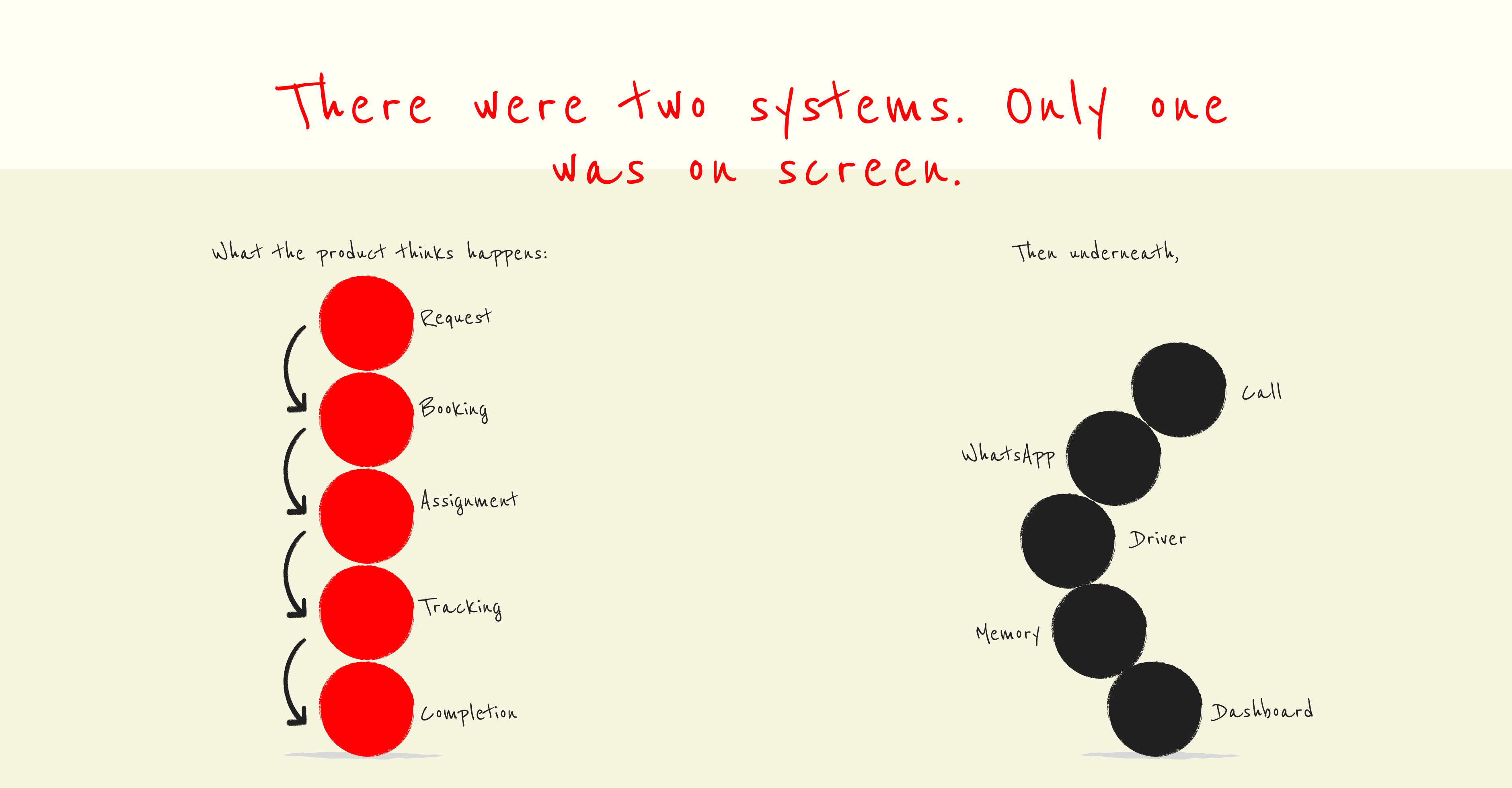
Emma is a hospital administrator at Felix Hospital. Every ambulance request, dispatch decision, and status update passes through her. In an emergency, the process rarely begins inside the product. A request arrives by phone. Details move to WhatsApp. Drivers share locations through messages. Some information reaches the dashboard. Some remains in conversations. The rest has to be remembered. The dashboard existed. The features existed. But the complete state of an emergency existed nowhere. Emma wasn't simply coordinating an ambulance. She was reconstructing the situation from fragments of information while trying to make decisions under pressure.
When people have to leave the system to get work done, the system has already failed.
I began with a conventional product audit.
The platform was evaluated at two levels: screen-level usability and workflow-level experience. I reviewed modules including Add Ride, Ride Details, Dashboard, and Reports, using heuristic evaluation and NASA-based severity mapping to prioritise issues.
The screens revealed genuine problems.
Forms required complete information upfront. Critical information wasn't surfaced effectively. Interfaces assumed linear completion even though emergencies were interrupted and incomplete by nature.
But improving those screens alone wouldn't solve the larger problem. Users weren't simply struggling to use the system.
They were working outside it. That changed the scope of the audit.
I mapped the operational journey across Intake, Assignment, En-route, Handover, and Closure, looking beyond individual screens to understand where information entered the system, where responsibility changed hands, and where communication broke down.
The analysis identified 15 critical and major workflow failures, including 8 at the highest severity level and 6 major operational inefficiencies.
The data flow revealed an even deeper problem.
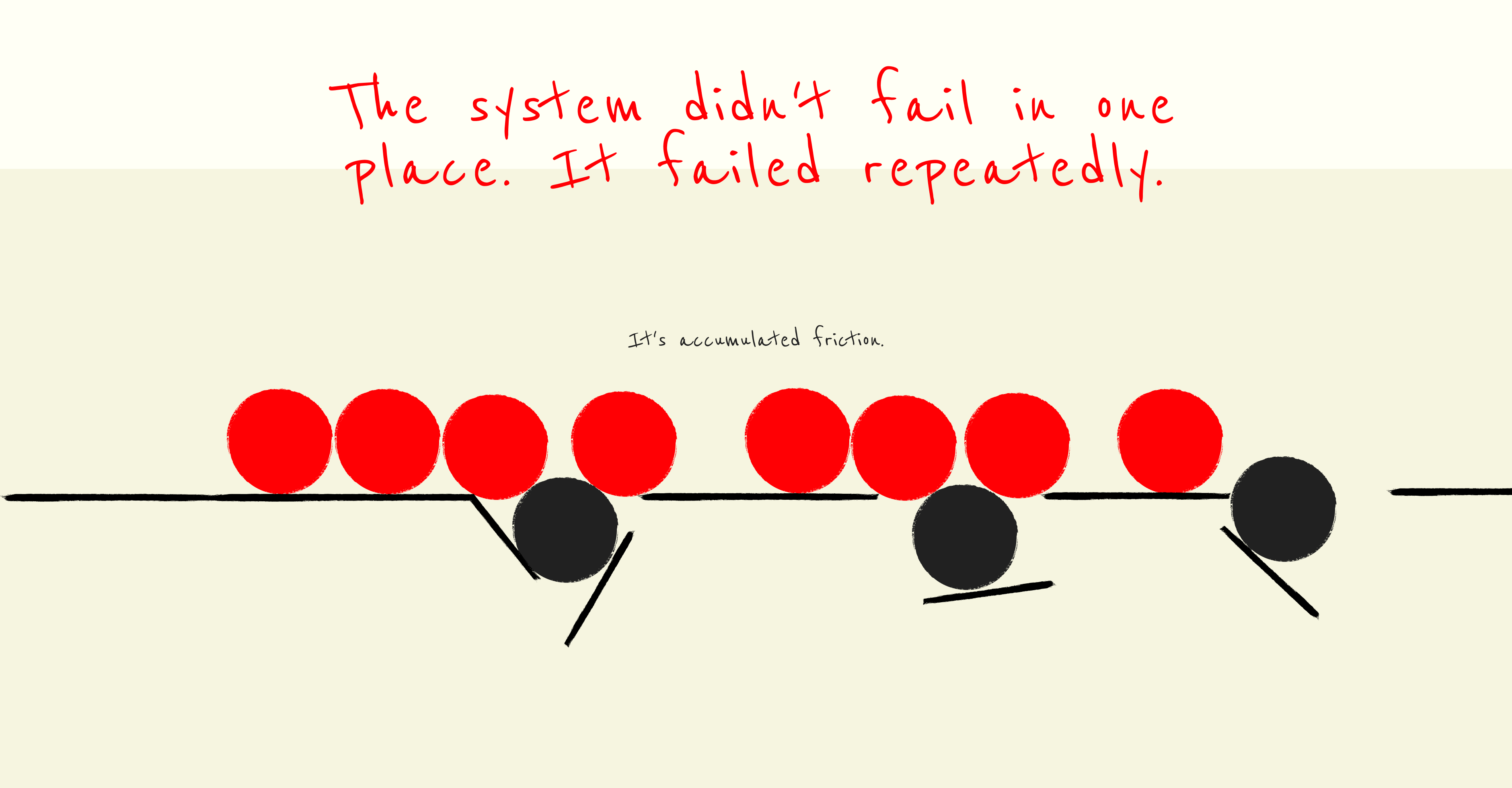
Information could be entered two or three times across different channels, with approximately 40% mismatch between final entries. Manual driver coordination added 5–8 minutes per dispatch and affected 67% of emergency cases.
Three structural failures emerged:
Fragmented information
The same information existed in multiple places, with no reliable source of truth.
Workflow mismatch
The product expected structured, sequential input. Emergency work was fast, interrupted, incomplete, and constantly changing.
Missing real-time visibility
Without system-driven updates, teams depended on calls and messages to understand what was happening.
Individually, these were UX problems. Together, they made the product unreliable.
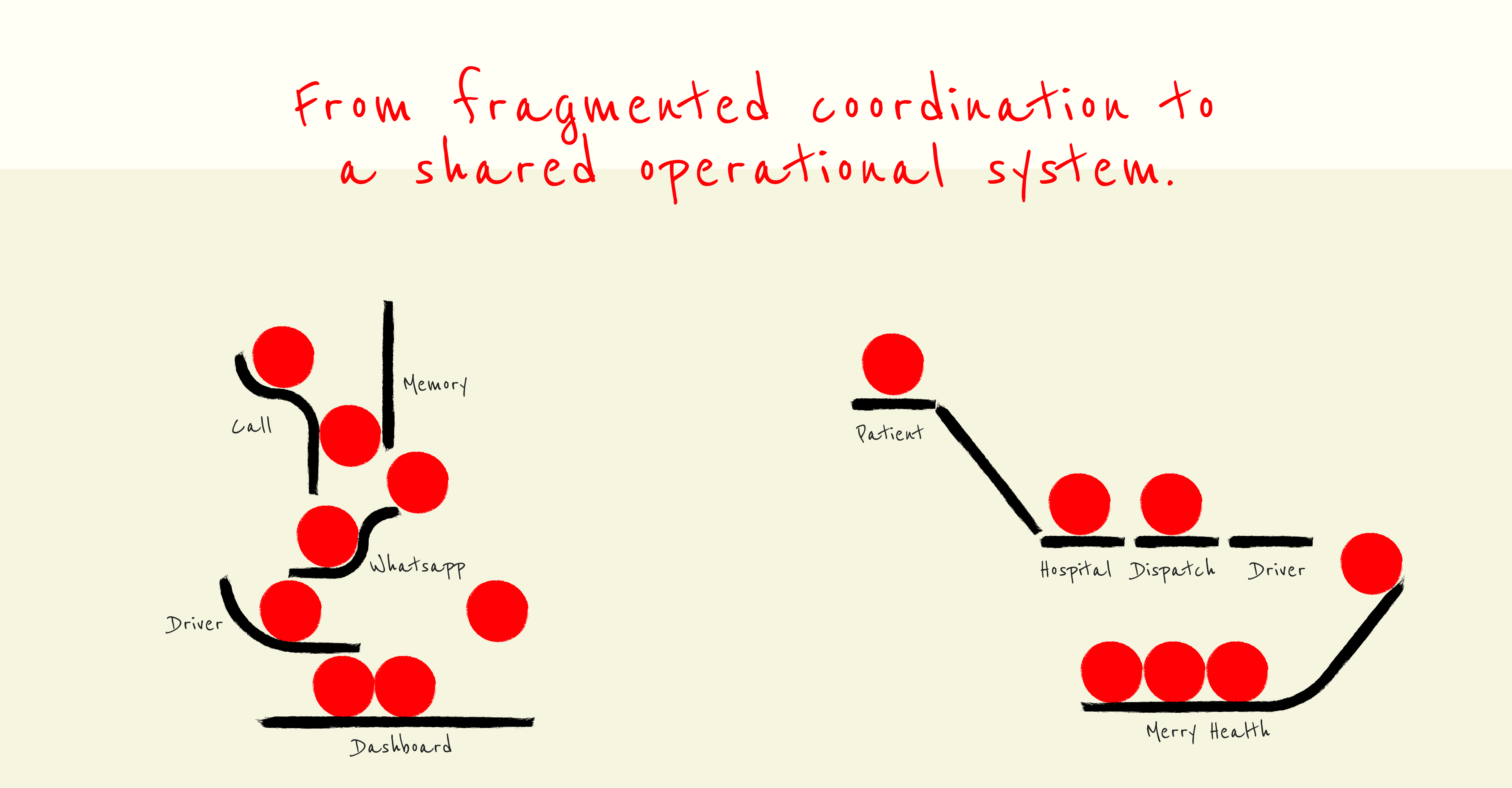
The audit changed the product direction. Instead of treating each interface issue independently, the team began looking at the platform as one operational system. Three changes became central.
One source of truth
The dashboard needed to become the authoritative record rather than a secondary place where information was entered after the real work had already happened.
A continuous workflow
The experience was restructured around:
Intake → Assignment → Tracking → Handover → Closure
Each stage needed to support the reality of emergency work, including partial information, interruptions, and changing circumstances.
Reliable information from the start
Data needed to be captured once, remain consistent across the system, and become reliable enough to support reporting and operational decisions.
The underlying shift was straightforward:
From fixing interfaces to fixing how the system actually works.
The work shifted the conversation from interface improvements to system-level redesign. The redesigned direction aimed to reduce dependency on manual communication, improve emergency response speed, increase trust in the platform, improve data accuracy, and support more reliable reporting and operational decisions. The important outcome wasn't a prettier dashboard. It was a different definition of the product's role.
Merry Health needed to become a reliable coordination system, rather than a digital interface sitting alongside the real coordination system.
Merry Health reinforced a principle that now informs how I approach complex products: when people leave the product to get their work done, the problem is rarely just the interface. The experience is shaped by the information, workflows, handoffs, and decisions behind it.
In high-pressure systems, reliability is a design problem.